<Insert cliche photo of hands locked together here>
Despite the cliche sound of having a team vision it is quite unifying and helps the team function as a team. I’m going to skip the convincing of why a team vision is important, and focus on the how to create a team vision.
Trust is the foundation of a team. These first steps are built to help a team establish vulnerable trust. The team’s core values by the end are only possible if there is a firm foundation of trust between the members.
Vulnerability based trust is predicated on the simple and practical idea that people who aren’t afraid to admit the truth about themselves are not going to engage in the kind of political behavior that wastes everyone’s time and energy.
— Patrick Lencioni
Also, as a disclaimer this is given sort of as a script of steps that I wrote to guide the team to find their vision. I’ve modified it a little in this post to give more context. Parts to deliver to the team are in block quotes.
A lot of my inspiration and concepts are from Overcoming the Five Dysfunctions of a Team and Start With Why.
Step 1: Fill out personal form
About 24 hours before the team meeting send this linked pdf document to all the attendees and ask them to complete it before the session.
Step 2: Introduction
Mutual Trust is critical for a team. It is probably be the most important characteristic of a team. Some say it is critical for a team to function properly at all. Trust is the glue for communication, patience, teamwork, and understanding of those personal values you identified. You picked your personal values, now we want to find team values. So let’s do the awkward touchy-feely-stuff.
<joke about virtual Covid-19 trust fall>
Seriously though, we need to learn more about each other in order to understand what makes each person the way they are.
Step 3: Personal History & Values
Go around the group and have each person answer the following questions. I suggest the leader goes first. Don’t forget to set the example of being personal and vulnerable.
- Where did you grow up?
- How many siblings do you have and where do you fall in order?
- What was the most difficult, important, or unique challenge of your childhood — of being a kid?
- What was your worst job or worst trip?
Go around the group again and each person state their five values from the worksheet and why they picked each one. This can be combined with the first, but I prefer them separate.
Step 4: Go over “Start With Why”
Simon Sinek has a concept called “Start With Why.” Watch his TEDx talk if you haven’t read the book.
<draw circles> and explain the concepts.
The “why” says why you want to be on a team.
Think about Apple. They have an identity they they sell and also a passion to keep things simple. When they invented the iPod, it was natural to want it. Contrast that to Dell selling an MP3 player. They are both computer companies, but it only feels natural for Apple. Now they are breaking into the credit card market, which for some reason doesn’t seem that surprising.
Think about VW in the 2000s, they tried to make a luxury car, but it only lasted 2 years in the USA. Volkswagen’s name means “The People’s Car”. You are supposed to place flowers on the dashboard. VW had an identity, a “why”, but when they made something outside of their “why” no one was interested.So how do we find our “why” as a team?
One way to detect the wrong “why” is by noticing an increase in stress or a decrease in passion.
The “Why” is a list of values, values shouldn’t be nouns/things. Not “honesty,” “innovation”, “communication”, etc. You can’t keep people accountable to nouns.
“Hey __, I need you to increase your innovation today.”
And if we have to write down something like “honesty” on the wall, we have bigger problems.
It needs to be verbs.
So Not integrity: it should be “We always do the right thing.”
So Not Innovation: it should be “We look at the problem from a different angle.”
Put the word “We…” in front.
Step 5: Team “Why” exercise
This is another interactive session. Everyone will need their computer for this. Funretro.io is a great interactive board. I feel that finding your why is sometimes quite challenging as it is often more of a feeling or idea. I found it easier to start on the outside, “the what”, and then identify “the how” and finally “the why.”
I created a board with these columns:
- Qualities (Result or “the What”)
- This should be the things that are happen at work (or maybe want to see).
- Examples: PTO, New Tech, Team Lunch, High-quality code
- Examples of How / Experiences
- This should be the things we experience. It is okay it have negative ones, but it should be primarily positive. These can include “We …” statements. Often these include “the why”, and the team will refine on these during the last step.
- Examples: Celebrate success, Share knowledge, Take risks, Work hard/play hard, Help for each other
- Vision / “Why”
- This is the final goal. Normally there will only be 3-6 cards here.
- Parking Lot
- This is a place to put thoughts that need expanded on when reviewing the columns, but they might pose to much risk or distraction at the time. Often negative cards can get put here. Then the negative idea can be investigated into why it happens.
- Examples: “We work really hard” or “What about quality?”
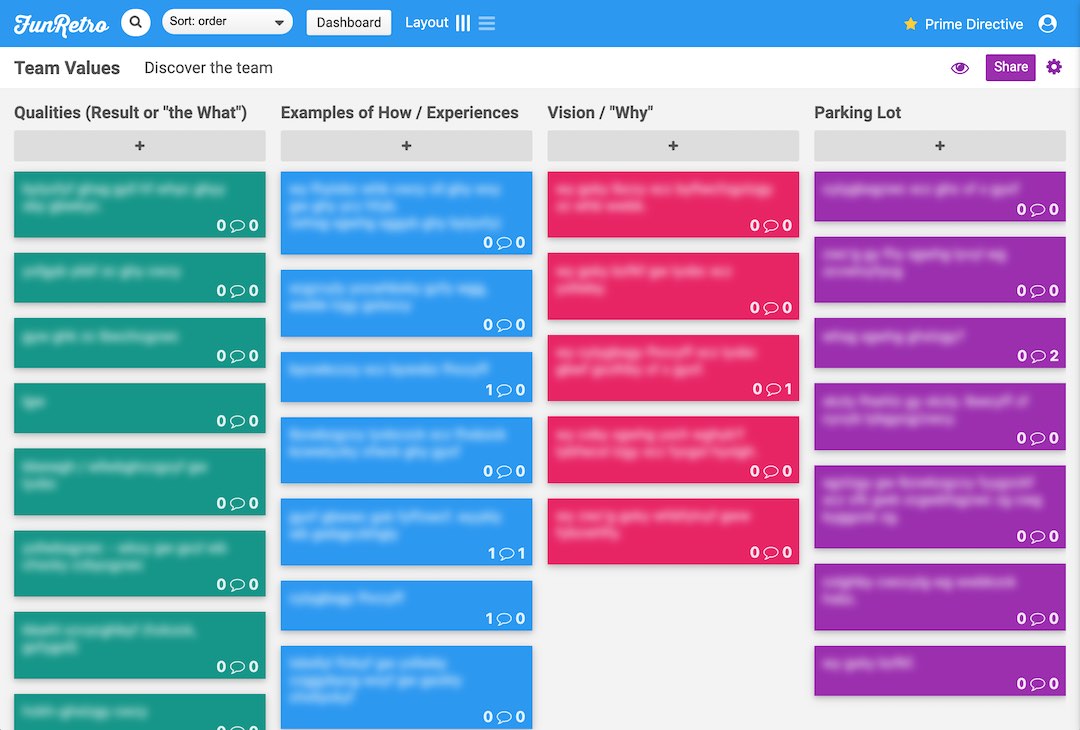
Each of these column should be done one at a time. Start with only the first column. Everyone gets 10 minutes to fill out ideas. It is often a good idea to hide cards during the first half or more of the 10 minutes so people can get ideas without distraction of others. After everyone is done, go through all the cards and encourage people to speak to them as you go through them.
When moving to the second column remind people what “the how” means, and that it is okay if they put items that feel more like “the why” too. Try to answer “the how” for all “the whats” from the previous column. Once everyone is done, go through them all together again as a team.
This entire exercise is long. It is good to take a break (multiple hours break is okay, but probably best to keep within the same day) between “the how” and “the why”. I actually like to break after people fill in their ideas of “the why”, but before we all review them as a team. That way we review all “the hows” and convert them to “whys/vision” together as a group.
The third column is best by having only the leader do the writing while everyone contributes ideas. Keep in mind that they need to have “We …” statements. It is also good to try and make the vision statements sticky (aka memorable). For example, if the team wants to identify with something like “We are humble”, try to find a way to make it more personable. Ask again, “Why?” Something like “We don’t take ourselves too seriously” might fit the team’s vision better. Especially if the team wants to capture “fun” as a core value too.
Other notes
If people struggle to find ideas, here are some “How” idea generators (I haven’t needed to use these):
- Write down a time at work when you felt the most happy or most rewarding.
- Write down a time you left work excited.
- Write down a time you were excited to go to work.
- Write down your favorite project you’ve done.
- Write down the most fun you’ve had at work.